







It’s been a whirlwind…

I have officially lost all track of time. In the past 5 minutes, or else perhaps it’s 5 years, the manchild finished school for the year, started summer day camp at the local YMCA, I got my copy of Amy King’s new book Spin Control, I went to Colorado to work on an exciting new project I haven’t gotten clearance to blog about yet, I saw the first laid-out pages for my book, I went to TNNA, my 40th Anniversary cherry Matchless arrived at my dealer’s, and officially started trying to make exercise part of my routine even though there’s no way I can fit it in.

Okay, it’s been 9 days, and I feel like today is the longest I’ve sat still (I think I feel that way because it’s true). I feel completely dizzy. And exhausted. And years behind on my email. And vaguely as if I’m forgetting at least 8 other things that have happened. But there are two pieces of big news. The first is that tonight, for the first time since I don’t remember when, I have time to spin something totally just for me. Something that isn’t committed to a project, necessarily. Something whimsical. Something I don’t have to spin, with no deadline. And I have absolutely no idea what to spin. None. I am totally at a loss. I can’t remember what to do with myself.

The second is that my book is officially available for preorder! I can hardly believe it, but, as my long-suffering editor said to me the other day, “This ruse that we’re publishing a book is getting expensive.” She was kidding. I hope. Seriously though, it’s real! It’s a real book. I saw real pages for it. With real pictures, and real words, and everything. It has an ISBN. It’s, you know, real. It’s really expected in November. And I’ve had a few folks ask me already where they can get signed copies. The first answer that came to mind was “Come where I’ll be signing them,” but when I said that in Amy King’s earshot this past weekend, she pointed out that with the wonders of modern technology, it’s actually possible for people to pre-order them, which she’d set up for her loyal Spunquistadores to do. “You should do the same,” she suggested. So I’m copycatting her, and there’s a link on the right nav bar where you can do just that if you’re so inclined. When the first copies hit the warehouse, I’ll get your pre-orders in, sign them, and send them out to you forthwith. Make sure you let me know who you’d like it signed to, or if there’s anything specific you’d like me to say.

But please do still come see me where I’m signing books… and I’ll let you know where that will be before too long. But in the meantime, I’m off to do my comfort spinning, and I’d love to hear what you consider comfort spinning!

32 Comments »

Some questions answered, and a daring plot

Several folks have asked how you do a criss-crossing wind-on. It’s pretty simple, and I wrote up the basics a few years back — with nary a question or comment! I demonstrated it with a low whorl spindle, and spiraling up the shaft to where you’ll do a half-hitch, but this same principle applies to any spindle. In this particular tutorial, I showed it at the starting stages — but you can do it at any stage at all. In the beginning stages, it saves a lot of wind-on time and usually helps keep what will become the interior of your cop from getting very slippery later on.

I’m going to digress for a moment here and reiterate something I think people don’t always realize intuitively. Ready? Okay then, here it is: lots of things apply to more than one type of spindle (or even more than one type of tool — so things that apply to the spindle often apply to the wheel, and vice versa). This criss-cross wind-on is a great example. The gist of the method, even though it’s shown on a low whorl spindle in this case, applies equally to a high whorl, or a mid-whorl, or any spindle.

Debbie raises an interesting point in a comment:

If seems to me that you are cheating a little by using a Woolee Winder as the comparison. If you were using hooks instead of a Woolee Winder, you could fit more yarn on the bobbin. The limit would be where the yarn hits the flier, instead of flat with the end of the bobbin. The yarn would pooch out in the middle of the bobbin, just like on the spindle.

Your main point that spindles can hold a lot stands up well without the comparison, however.

Interesting cop building method. Is this traditional Chinchero or your own take on how you find it most efficient?

I would absolutely agree that it’s possible to pack many standard bobbins much fuller than a WooLee Winder (although that, too, is something one can find debate over — because packing a bobbin to maximum fullness is also a skill, and the WW is no substitute for that skill in the final analysis). Certainly, that would be true for a standard Majacraft bobbin, and that would have addressed that in the specific case shown. For the record, the example shown — with the plying finished using a spindle — wasn’t something I set up to prove this point; it was something I encountered never expecting that I had more to ply than would fit on that bobbin, for a planned yarn where failing to get it plied as expected would have ruined the whole idea.

To illustrate Debbie’s point, here’s a bobbin packed full on my old Roberta electric spinner — which has a tensioning mechanism that makes for pretty tightly packed bobbins, to boot:

and another view:

The spun yarn on the bobbin is rubbing on the flyer arm in many places, and it’s no longer really possible to wind on stably in a way that yarn won’t slip off the ends and tangle around the flyer shaft. This can also happen after removing the bobbin, such that problems occur:

and in my experience, I have found these limitations on bobbin and flyer assemblies to be more absolute than the comparable limitations for packing a spindle full. But again, it also depens on the specific equipment. Not all bobbins can be packed to be fuller; not all spindles can be filled to the same extent; your yardage will vary, as they say.

Thank you, Debbie, for raising this — it’s a great discussion point. As to your last question, in Chinchero, while cop building is still unique to each spinner, there’s a strong aesthetic towards the bell-shaped cop, and this is sort of an upside-down interpretation of that aesthetic. Some spinners do criss-cross to stabilize things, but it’s not universal.

In other news, I am daring to hope.

These are four seedlings — cotton seedlings — which are not yet dead. They were planted with seeds from the one plant that made it last year, which produced two bolls. There were six in this pot, which we started inside in early May. One seed never sprouted, one sprout died very early, and these four are not dead yet. Based on this, I am, as I say, daring to hope.

There are four seeds each in these pots by the garage. There are also four more that have been added to the six that were in another pot, on the deck, that we planted at the same time as the indoor-started ones, and those have never sprouted.

I am daring to hope that a few plants will make it in each of these containers. This is a huge hope for me, because I’m not good with the whole plant-growing thing. Usually, my plantings look rather like this.


But sometimes crops work out okay if I’m involved. Houseplants never; crops, okay. Even so, I often think it best if I view the garden as belonging to my better half.

And yet, I dare to hope that it will yield tasty tomatoes, peppers, basil, and cilantro for us all to enjoy.

Our son is not plagued by my plant misfortune. Years ago in California, he planted a few sunflower seeds, and they grew into 12-foot-tall behemoths that eventually collapsed under the weight of their yield of seeds. We saved at least a pound of seeds, and this year, he planted some.

There were many here, but this crew has been beset by slugs or something, so a lot of ‘em didn’t make it past being very small.

These have done a little better, though again there have been some losses. But we all dare to hope that perhaps the manchild’s sunflowers will again grow huge and tall.

Please wish us luck with our green things.

10 Comments »

Spindle Full, Spindle Empty, Need More Spindles

There’s a lot to say about filling up a spindle. I often hear from folks who have been told that a big problem with spindles is that you just can’t put a lot of yarn on them, and that’s one of the reasons why wheels win out.

The thing is, it isn’t true. Flyer wheels have absolute limits in terms of how much you can put on there: once the yarn on your bobbin is rubbing the flyer arms, you definitely can’t get more on there, no matter how much you want to. Let’s roll back the clock to 5 years ago or so…

I had a WooLee Winder bobbin full with at least 500 yards and 5 ounces of 3-ply yarn, and there was just no way to get the last bit on there, but it was completely mandatory that this be one skein because I had planned out this whole colour sequence thing in overly elaboraqte detail. I was seriously annoyed; “If I were doing this with a spindle,” I said, “it would have been no problem at all to just get the last 30-40 yards crammed on there. Grrr.” So that’s what I did:

I wound all three singles together into a butterfly, then plied from the other end onto my Peruvian canti (plying spindle) and the problem was solved in no time at all… other than that I had to pull the stuff on the spindle off through the orifice and closed-ring hooks on the WooLee Winder, so I could skein the yarn off the bobbin.

I still remember sitting there thinking, “I so would not have had this issue and waste of time if I’d just been using a spindle to ply this from the start.” Any time that I arguably saved with the wheel and WooLee Winder combo had been eaten up in dealing with this limitation. I knew from experience that I could put at least 8 ounces onto that spindle and it was a real shock to come up against the hard limitations of fancier equipment.

Mind you, this doesn’t mean you have to cram a spindle insanely full all the time. It can be a great way to work with thread and small quantities.

This is an impossible to photograph project that I’ve been poking at here and there for a few years. It’s some merino/cashmere top that I split up carefully and wound into small packages to preserve the colour sequence, and I’ve been gradually spinning little bits, winding it off onto another spindle, then winding it back onto a pair of matched spools for electrical wire that… well, it’s a long story. But this is one of those funny little extreme frog hair projects I constantly have in the background. I do the rewinding when I get to the point that I’ve used up one of the small colour-sequenced pieces. Someday when I get to that point, these two electrical spools will be full of super delicate merino/cashmere thread ready to be made into a carefully-controlled 2-ply thread with enthralling colour shifts.

I’ve got a similarly sized-spindle sitting by my slothing chair in the family room right now, and I’m periodically, carefully, meticulously spinning the yield of my first cotton crop: two precious bolls worth. This is intended for a SOAR project, because the cotton seeds came from Phreadde, and it’s a miracle that I grew plants without killing them, and cotton actually happened. Some seeds have been replanted this year, and if all goes well I’ll have at least 4 times the yield, and gradually, as time goes by, I’m going to get to where there’s a meaningful amount of cotton, from the half-dozen seeds Phreadde originally gave me at SOAR 2007.

I guess we can also take a sideline here and talk about why it is I really do desperately need more and more and more spindles, even if I keep getting spindles that seem incredibly similar to ones I already have. Here’s one reason.

I can’t remember, until I wind off, whether this was half of the singles I was doing for a specific project which explained managing colour sequences… or all of them. I have to wind off this spindle neatly and track the colour changes so I can remember, because I lost my notes. But I do remember that I was winding the cop with an eye towards showing the colour changes, and I took all these pictures along the way, and… yeah. Great. So I have to spend an afternoon going through those photos and winding that yarn off carefully, and then I can remember what I was gonna do next.

This one isn’t done yet. I just have to remember where I put the rest of the fiber.

I can’t wind off this one until I get a good picture in the right light, because in real life, it’s insanely pretty. But all my pictures keep not coming out. This spindle was Divine Bird Jenny’s, but we swapped some stuff. I love it that it was hers so I want to take pretty pictures of this yarn on it.

And then there’s this one, also plagued with the same problem, which is that I really want to take pictures of it as it is, because… it’s pretty, and something else (I’ll get to that). It’s my prettiest Bosworth in my opinion, and I spun this cop for exhibition purposes. I wanted to show something specific.

Can you see it in this picture?

I think it’s easiest to see in this one. The top part of it — closer to the whorl — is wound criss-crossing, and the lower part of it is not. Why would I do that? The answer is first of all that switching between these methods is part of what lets me build a stable, dense and full cop (the cop, remember, is the spun yarn you’ve stored on your spindle). Winding around and around packs the yarn tighter, but it gets slipperier and sloppier more quickly. Winding in an X holds it more stable and winds on more yarn per twirl of the spindle, but the packing isn’t usually as dense. Combining these methods allows for the best of all possible worlds in packing a spindle.

This was my carryaround spindle for about a month, then my sit-in-the-kitchen spindle for a week or two. It’s an 11 gram Bosworth featherwight, and it’s got 66 grams of merino/silk singles on it. For me, this is pretty much a functional limit with this spindle. The spindle still spins totally fine and would work for ages more, but I’m out of space for the yarn to go without compromising the shaft pace I need to set the spindle in motion, the stability of the cop, or the ability to keep the spun yarn securely in place when I start spinning the next length. More than this, and it would start to get annoying.

Allright, the truth is, it started to get a little annoying in the last few grams. But — and this is where I was going at the outset — it got a little annoying. It didn’t get impossible. I wanted to get the whole batch onto that spindle, so I decided to, and it went on there. There are ways — which there aren’t when you hit the hard limits of a bobbin and flyer.

At 7 times its unladen weight, the spindle performs fine — but differently from how it did at 11 ounces. I’d be lying if I said a brand-new spinner could do this. It takes time and practice, knowing the tool, knowing the yarn, knowing your own habits and tendencies.

I won’t know for a while — until I’ve wound it off, plied it, and measured it — just how much yarn there was here. But I’m reasonably sure it’s, well, a lot. I’m going to hazard a guess I’ll get around 600-800 yards of 2-ply yarn from this when all is said and done. I’m tempted to skein it and measure it as singles, for science, but I’m just too lazy right now and besides, I want it in plying ball form for an impending project that requires demonstrating that.

In any case, don’t let anybody tell you spindles don’t hold a lot. It isn’t true. On the other hand, what does appear to be true is that you need about 8 zillion spindles to have enough. I truly hope this helps.

27 Comments »

Spindle Positions

Wow, I want to thank you all for the terrific responses to the question about spinning standing up vs. sitting down! I would urge anybody who hasn’t to read the comments — there’s some fantastic food for though there.

Here’s why I asked: over the past few months, I’ve heard lots of people say lots of different things about spindle spinning positions, some stated very authoritatively and completely contradicting each other. In some cases, when I’ve talked to folks about these things, they’ve told me they were told in no uncertain terms that you really couldn’t spin sitting down, or standing up, or without reaching your hands way up over your head, or without using your whole body, or all kinds of things. So I started to wonder: first of all, who’s hearing these things, and second of all, who’s telling them?

What’s interesting is that if asked, a lot of people can’t remember where they heard, say, that you can’t spin standing up; others say that it just never occurred to them that they could sit down; so there really doesn’t seem to be an elite cadre of misinformation ninjas out there telling people untruths about the spindle or anything. But things that seem obvious to some of us, it turns out, are totally not. And some of the things we assume may even be mistaken.

I, for instance, assumed it was obvious you could just sit down. Or stand up. But then someone told me she’d found a particular video helpful learning to spin (which I thought was interesting since the video didn’t actually cover what most of the world has considered to be “spinning” for thousands of years), and I asked her what she’d found helpful about it — after all, I’m always looking to improve on my toolkit for getting folks started and reducing the time it takes them to be able to be hands-on trying it in ways that lead to rapid success. “Oh!” she told me, “Mostly it’s that the lady in that video is sitting down. All the other ones, people are standing up. I want to learn a spinning method that can be used sitting down, not one that requires me to stand.” You could have knocked me over with a feather. I made a mental note to add “And of course, you can sit or stand as you prefer,” to the things I make sure to say when teaching a brand-new spinner.

You can spin, or ply, standing up.

You can spin, or ply, sitting down.

You can spin, or ply, while walking around. Heck, you can do it while dancing.

Something else to remember is that when it comes to spindle ergonomics, we’re all different and spindles are largely different from each other, and this is one of the great strengths of the spindle: you can figure out what works best for you personally. With a wheel, you’re restricted to some extent by the shape and size of the equipment — but with a spindle, your range of motion can be anything at all.

So if you’ve only felt you could do it one way, how do you get to be able to do it other ways? You’ll all hate me for this, but the answer is simple: just give it a try. At first it may feel awkward, but that’s normal enough. It takes time for a new movement to feel comfortable. And if you’re just starting out, I would urge you to vary your position a lot, and try lots of different things. You might be amazed what a difference it makes to be able to spin comfortably in any position at all.

21 Comments »

So here’s a question

I’m hearing two questions asked a lot lately, and I’m intrigued about them, so I figure it’s time to Ask The Blog. Are you ready? Okay, the first question is:

“Can you spin with a spindle while you’re standing up?”

and the second one is:

“Can you spin with a spindle while you’re sitting down?”

So I’d love to hear from you: how do you do it, and why? When you were starting out, did you strongly believe you had to do it one way or the other? Do you remember why you may have thought that? Has your opinion on the subject changed over time?

117 Comments »

Teaching Schedule 2009

Upcoming classes / events:

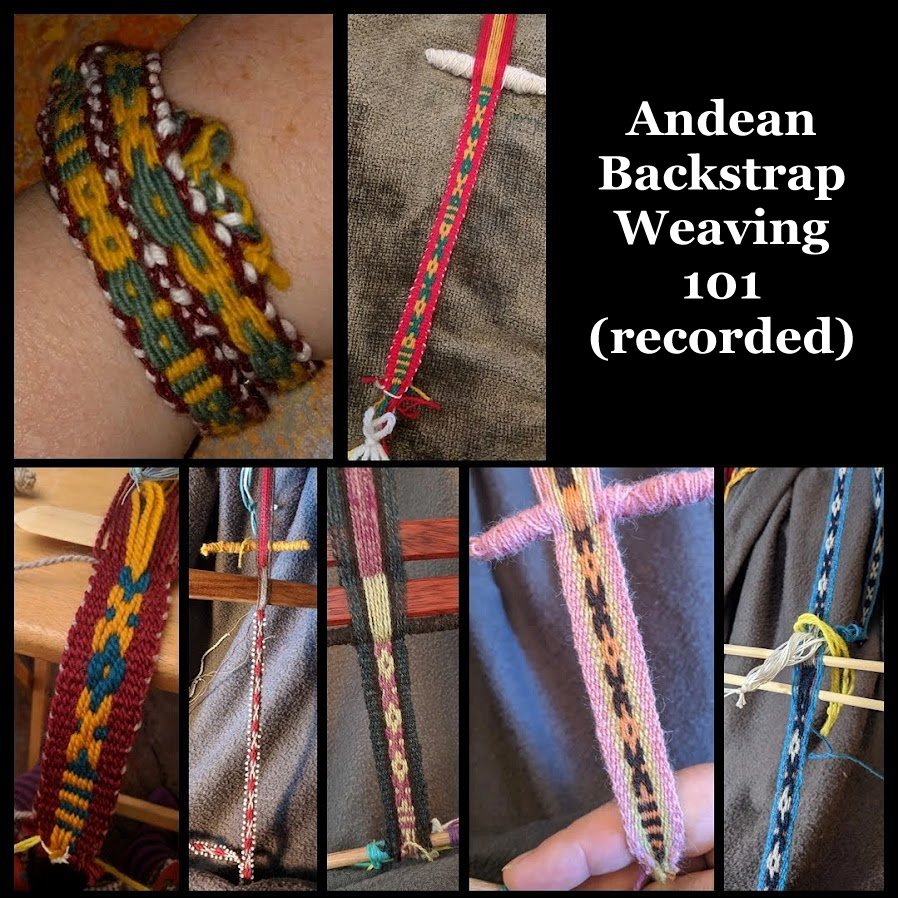
at The Spinning Loft, Howell MI; Friday evening 6 p.m. to 9 p.m. and 9:30 a.m. to 4:30 p.m. both Saturday and Sunday. Class space limited! Learn backstrap and pickup techniques in the traditional Andean way, using traditional patterns and methods, you’ll start with weaving, then move your way up to warping and tying heddles. This class will run from Friday evening July 17 through Sunday July 19.

at Tina Newton’s

, Portland, Oregon, August 6-9, with Denny (yes, THAT Denny) McMillan. Ideal for the brand-new spinner or the wheel spinner looking to get comfortable with spinners, Denny and I will serve as the spinning gateway drug pushers and open up the whole world of spinning for you.

in Frankfort, Kentucky, September 26, 2009, 10AM to 5PM; 800-441-9665 to register.

at Sun River Resort in Bend, Oregon, October 25-November 1. I’ll be teaching a 3-day workshop on drum carded blends, and a half-day retreat session on the same topic, 4 times.

There are a few more dates not set in stone yet, and I’ll update this page when those are firm.

8 Comments »

Too Much Twist

So how much twist is really too much twist? It’s common for spinners to talk about something having too much twist, especially if they’re new — but the truth is that yarn can handle way more twist than you’d think, and the exact right amount of twist is really subjective. When I’m talking about the question of too much twist vs. too little, I like to describe it this way:

Too little twist: Your fibers can still be drafted; the yarn slips and tries to keep thinning out, and with sufficient weight or tension, would drift right apart.

Too much twist: Your fibers are all so tightly twisted that the only thing they can do is kink up on themselves super-tight to ease the strain. When you try to pull them out straight, the yarn snaps.

All yarn, as you’re spinning it and before the twist has settled, or it has been plied and finished, will kink up on itself. That’s normal, and it’s supposed to! If the singles you’re spinning don’t kink up on themselves, you probably don’t have enough twist for your yarn to be structurally sound.

And that’s the crux of the matter: yarn has too little, or too much, twist, when the amount of twist causes it to be structurally unsound. This means there’s a huge spectrum in between too much and too little, and that whole spectrum is okay. It’s up to you, as the spinner, to decide where along that spectrum you want your yarn to fall, and you would make that choice based on many, many different things. When you’re starting out, I recommend erring on the side of having what feels like more twist than you want. Chances are, it’s actually less twist than you think it is, and besides, there’s a lot more you can do to salvage a yarn that’s a little twistier than you ideally wanted, than to salvage a yarn that is so loosely spun it simply drifts apart.

These things said, my son recently provided me with a great visual example of what happens when you get too much twist.

Here we have one computer headset, suitable for… you know, everything a tween could possibly want to do with a headset on a computer, plus for keeping Mom in her office from having to listen to the same song over and over and over again (hey, does that end? I know it ends; I don’t do that anymore, but when did I stop? Is there hope that this will end before he moves out?). This headset is dangerously broken, though you can’t tell from the picture above. Maybe this will help:

Can you see what’s going on with that cord? Well, let’s look closer.

Up at the top, you can see where it’s kinking up. Down at the bottom, you can see where it’s… got issues.

Here’s what happened. Every time the manchild would take off the headset, he’d drop it on his desk or the floor (sigh), and do it in such a manner as to introduce a single twist. When he would put it on, he would pick it up (usually from the floor), and give it another twist to orient it correctly before donning it. In this way, much twist was built up in the cord, and after a time, it kinked up on itself and became short enough that it wouldn’t reach his head. To solve this, he placed his hands on either side of the kink, and yanked it out straight. And just as with yarn, this cause breakage.

Oh yeah. As you can see, the headset cord is actually composed of a number of fibrous things internally, protected by a vinyl tube on the outside. This tube is intended to shield the headset’s cables, keeping sound transmission clear, and preventing other potential electrical hazards (though granted, those risks are pretty low with a headset, but then again, if it’s being thrown on the floor of a tween’s bedroom, you just never know). It is the tube which has failed structurally due to excess twist. The wires inside are somewhat more twist-tolerant — but in time, these too would fail.

You can see it above getting ready to happen. The vinyl is stretched and stressed by twist, and the wires are starting to poke through at the main kink-up point. This same thing will happen with the fibers in your yarn — first they will get stressed, and then they will break. Just like this headset cord, your yarn only has so much twist-carrying capacity, and when you exceed that, it will give way.

The correct solution to this problem, as we have explained to the manchild with his new headset (because seriously, I cannot work in my office if I have to listen to whatever soundtrack it is that has been put to Bionicle videos on youtube, and there are times when I absolutely must be working in my office and simply do not have the strength of character to engage in the lengthy argument about turning that crap down, particularly given the karmic sledgehammer that is yet to come my way in this respect due to the fact that I spent my teenage years playing the guitar for 8 hours a day), is to remove the twist. This can easily be accomplished by unplugging the headset and allowing the twist to run out, or, if the twist has started to settle, holding one end of the cord and spinning the headset in the opposite direction to remove the twist.

He has also been warned: his mother is very, very good at gauging twist, and will not have a problem detecting failure on his part to properly manage twist in his new headset.

In other news, today is registration day for the Spin-Off Autumn Retreat. Here’s wishing you all great luck and the classes you’re hoping for, and I look forward to seeing you there.

25 Comments »

Dear My Book

Dear My Book,

Okay, listen. This is a difficult time in our relationship, and I know we’ve been spending a lot of time fighting with each other and it’s been stressful, but first of all, I want to be sure you know, I mean REALLY know, that I’m deeply committed to working this out. I believe in us for the long-term, larger picture. When I look deep in my heart, I see a future with us together, happily working towards the same goals, sharing the good and the bad. I truly believe in that. I’m not losing my faith in that just because we’re having a rough time right now.

But that said, I would really like to clear the air between us, and I don’t feel that’s been happening effectively just going about it the way that we have been. So I’m going to try writing my feelings down and handing them to you, and it would mean a lot to me if you could take the time to read them, without just reacting angrily or anything — just read them, and think about them, and then after a while I’d like it we could talk through them all rationally.

Sometimes it’s hard for me not to feel like I’m in this all alone, and like I’m the one doing the heavy lifting, while you just sit there, cold and impassive. I can’t tell what you’re feeling. That makes me feel like it’s all my faith carrying us, and I don’t even know if you believe in that long term goal. It’s hard, when I don’t even know if you really want to be in this with me or not. I wish I felt like I had a clear picture how this strife of the editing process made you feel.

Other times, I feel like there are too many people involved — why are you talking to our editor so much? What do you guys talk about? You guys go off in secret without me there, and then you come back, and you start spewing things at me — this has to change, I can’t live like this, who’s taking out the trash, if you ever really loved me you would have remembered to pick up bread on the way home. I know she’s influencing you and it makes me feel powerless. Some of the things you’re saying to me when we fight I know are straight from your heart, but others just ring like something she said that you’re repeating. I’m glad you have an advocate and a champion but I also fear she’s putting things in your head that you wouldn’t otherwise think.

Every time I think we’ve worked through a major issue, it seems like there are more waiting in the wings. You’re angry at me when I take a break to eat or see my family for a few minutes. I don’t understand what you have against my family. They love you. Why can’t you see that? It’s not reasonable for you to try to cut me off from them. I don’t think that’s acceptable for our relationship. I don’t like how you control my days so completely.

I understand we have real issues that need to be worked through, and that we have limited time in which to resolve our conflicts. But even in spite of my faith that this is going to work out and we are going to live happily ever after, there are times when I desperately just want to run away. I want to tell you I think we need some time apart, maybe even to see other projects. It’s not about you, it’s about me: I need to recharge my batteries. Focusing so closely on you can’t be healthy if it continues like this. I know you feel like I’m just ripping your guts out over and over and making us hash over the same old things again and again, but sometimes that is what it takes.

I’m sure that someday down the road we’ll look back at all this and smile, happy that we worked through it and stuck it out. I can see that being as soon as November. But right now, I just wish you could cut me some slack, and starting putting a little of your own energy into making this whole thing go. At the very least, please respect that this is hard for me, and maybe just fend for yourself a little bit so I can see my family, or maybe hang out with the blog now and then. They’re not a threat to you. This is a done deal and it is going to be okay. Someday, the clouds will part and we’ll laugh and smile again. I love you, even if it doesn’t feel like that right now.

Yours always,

Your Author

18 Comments »

So what’s your EDC?

A few weeks ago my husband said to me, “So have you ever heard of EDC?” I thought about that. The only thing that leapt to my mind went way back to being pregnant, when that stood for “Estimated Date of Confinement,” and referred to, you know, your due date. Somehow I didn’t think that was what he meant, though, so I said, “I’m not sure.”

“It stands for Everyday Carry,” he told me. “Check it out — there are forums and stuff, where people are talking at length about what they carry around every day.”

I thought about that for a minute. “You mean,” I said, “like my pocket stuff?”

“Yeah,” he replied. “And then there’s extended EDC — and that’s like your bag that you always take with you.”

“Huh,” I said, pondering this idea as a discussion topic. Now, don’t get me wrong: as a fiber geek, I frequent a range of forums and mailing lists and the like where people discuss exotic and obscure stuff in excruciating detail. So I’m definitely not down on the idea — it just hadn’t occurred to me that this was, you know, something people got into talking about. “So,” I asked, “what is there to say on the subject? I mean… what, like, this is what I have in my pockets and why?”

“Exactly,” he said. “Plus details about the stuff, and what you could do with it.”

“Huh,” I repeated, still thinking. I mean, I actually have a specific list of things I truly can’t cope with not having on my person, and I’ve been known to totally rant about it. I’m an extremely pocket-oriented person and I like my tools. I’ve come a long way and stripped down to a point where I actually carry a lot less stuff now than I used to. But still, there’s a core list of things I can’t cope with being without, and my wardrobe choices and lots of things about my lifestyle actually revolve around what I now was realizing was a concept people actually, er, have a name for. And forums about.

“In fact,” said my long-suffering better half, “people even make YouTube videos about their EDC.”

“What? Seriously?”

He showed me some. I felt torn. On the one hand, it seemed… strange. Self-important to think of making a video about the crap in your pockets. And voyeuristic to watch. But, you know… interesting. “You should do an EDC post on the blog,” Chad suggested, half-joking. O, the absurdity — after all, who’d want to know what’s in my pockets, or the bag that hangs by the door so I can grab it on the way out? And what’s next after you start telling people that, going into detail about the stuff that lives in your car? I mean, I’ve talked about the emergency knitting and spinning stuff. I’ve thought about blogging my packing process, and then concluded I just am not sure I want the world to know what my real life ratio of socks to spindles in my suitcase is.

But with a few weeks of consideration, I decided I really was going to do an EDC post. And this is it. And it even comes with YouTube videos. Seriously, I’ve emptied out my pockets and my little carry-around-town bag (it’s totally not a purse, I would never carry anything so girly as a purse!) and decided to share. Here you go. First, what’s in my pockets…

…and what’s in my carry-around-town bag.

I’d love to hear from all of you about your EDC. I wonder what we have in common and what we don’t? For example, most chicks would probably have makeup in their EDC. I do own makeup, but… it’s not an every day kinda thing for me. And some people are capable of feeling comfortable without a knife and fire, but I’m not — I don’t even really like going outside and walking around without those things. I started carrying a knife and fire of my very own when I was 8. Anyway, I’d love to hear what you carry! Tell me about it, blog about it, let’s go!

38 Comments »

Introduction To Spinning: 2 New Videos

A couple of years ago I made a video called Drop Spindle Basics to demonstrate, well, the basics — the most elementary parts of spinning.

Since it’s been up, I’ve gotten all kinds of feedback on that video, ranging from “THIS IS AN AMAZING VIDEO. Thank you so much for sharing your knowledge with the world. This information and wisdom will go far in my life. Thank you from the bottom of my heart,” all the way to “Details of what you’re doing would be nice - I can’t follow what’s going on with just frantic motion.” (I admit, that latter one pushed my buttons, and it took great emotional reserve on my part not to reply with “Have you tried listening to what I’m saying? Turn up your sound,” or “Come over here and say that to my face and I’ll show you some frantic movement!”)

I’ve also spent a bunch of time watching other videos, thinking about them all, and of course, engaging in a wide variety of teaching activities. Over the past 6 months, I’ve been saying, “If I had it to do over again, I’d change this, or that, or the other thing about that video, to speak to this, or that, or the other concern.” And of course, the funny part is that obviously I do have it to do over again any time I feel like it, right?

Well, any time I can steal a minute or two and a camera operator who knows where to zoom in, perhaps.

So what issues did I end up having with the first video over the past couple of years? Lots! I still like the video and think it’s a solid demo with enough information to get you started. But there were things I hadn’t anticipated. For example, I specifically chose low-cost materials so as to be very approachable, and show that even without fancy equipment, you can do all kinds of spinning. I tried to tailor the video to the lowest common denominator in terms of tools — to the simplest, cheapest spindle option likely available to a majority of folks who’d watch the video. This choice turned out to have unintended consequences — like people reaching the conclusion that the video’s only for spinning with a low whorl spindle with no hook. It isn’t — yes, it tells you how to do that; but drafting is drafting, spinning is spinning, and the same basic technique applies. Yet, people got caught up in what was, to me, just one fairly superficial thing about the video.

Also, I wanted more “spinner’s eye view” stuff. When I teach, I often stand next to a student, instead of in front of them; I wanted to create something closer to that effect. While a video still lacks the interactive nature of being there in person, I wanted to do something closer to my ever-evolving 5-10 minute basic spinning lesson on the quick. And I wanted to answer questions that people seem to often be left with.

On the other hand, I also didn’t have it in me to spend a ton of time, or, well, any money at all on something to throw on YouTube. There’s a limit to what I’m willing to do in that context, after all. So without further ado, here you go: Intro to Spinning Part 1 and Part 2.

Enjoy!

28 Comments »